



The most natural environment for dogs is still the forest. This sounds good, but is it really true? Yes, because in the forest there are no rules to follow like in the city: they can step off the small path, there are no curbs, and they get plenty of new experiences. Two of our experienced guide dog trainers shared their thoughts with us.
The forest prepares our dogs for the noblest task
Emese Királyné Barkóczi, our guide dog trainer, is an experienced hiker who loves trail running, running with dogs, and has organized trail runs for our guide dog pairs on several occasions. Since we train guide dogs, meaning teaching is our priority, we asked Emese to summarize what puppies and dogs in training learn in the forest:
“It’s extremely important for the puppy to learn to follow the person, to trust them completely, because that’s when they will cooperate excellently during their training later on. The forest is an excellent practice ground for this. Meanwhile, they discover nature and satisfy their curiosity with all their senses: there’s smelling, chewing, and other sensations – what scents surround them, fallen branches, slippery, leafy, rain-dampened surfaces. They can become familiar with the scent of wild animals, and may even see wildlife. They climb slopes, step over tree roots, wade through puddles. They gain a ton of experience.”
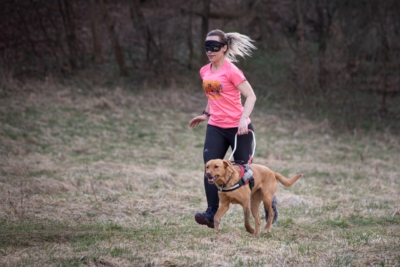
Emese Királyné Barkóczi trail running blindfolded with her dog
It’s no wonder that both the puppy raisers and trainers at our foundation love the forest. The puppy needs to belong to someone, and here they only need to focus on not losing sight of their raiser – that’s why the forest is also a good community builder, because here they will stay with us wherever we go, as they can only rely on the bond they’ve formed with us.
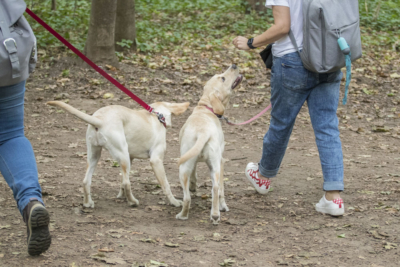
The photos in our article were taken at the monthly puppy meetups and the regular weekly Marcsi-runs
We trainers also “take advantage” of the fact that we lead the newly arrived trainee around one year old, to a junction where there are multiple directions to go, and we head down one of them – a well-bonded dog will follow us.
So for both puppies and guide dog trainees, it’s a good bonding experience to climb hills together and run down slopes. There’s almost always an opportunity to send the dog up onto some terrain feature – most commonly a fallen tree trunk that they jump onto, which develops their motor skills and body awareness, and it’s even part of the training that we take a few photos of them, as they learn to stay in place during this. This is an even bigger challenge and good practice in the company of multiple dogs. For a future guide dog, a small wooden bridge or going up and down the metal stairs of a lookout tower shouldn’t present an obstacle, even though you can see down through the gaps, which would dismay many dogs. In the forest, we can work through this mild spatial anxiety if the dog has it. A future guide dog must learn that these artificial terrain features, such as stairs, are completely safe and stable, so they don’t need to fear falling into the depths.
Our school’s special practice, the “find your way back exercise” is also conducted in the forest. A detailed description would exceed the scope of this article, but essentially, in the nature the guide dog trainee learns that they must help their trainer, and with this fundamental knowledge, later they can learn the guide dog profession.
When we want to make the dog’s task more difficult, we leave the tourist trail and go 100-200 meters deeper into untraveled terrain. Then the trainer covers their eyes and gives the command “take me back”. Our goal with this is for the dog to lead us back to the tourist trail choosing the most optimal route possible. It’s important that they don’t do it mechanically, like following Ariadne’s thread, but rather guide us back on the most optimal path, and of course meanwhile watch out for my physical safety among the holes, tripping roots, and branches. This is similar to when a guide dog leads their handler out of a crowded market, where the people are like the trees, which of course significantly complicate the task by moving around randomly. In other words, this is a good practice exercise for real life.
During forest walks we also teach check in, meaning that the puppy and trainee should appear and nudge our hand from time to time. The goal is for them to come completely on their own, without us heaving to shout.

Of course, discipline exercises are not neglected either, they must learn that if, for example, a hiker or cyclist comes toward them, they shouldn’t run over to check them out, because a guide dog shouldn’t be intrusive even when not on a leash. It’s important to know that our guide dog trainees don’t go more than a few meters away from us during excursions, continuously check in, and don’t endanger forest wildlife either. A puppy released with a long leash is easier to stop by stepping on the five-meter “strap” if needed for any reason, which is why our puppy raisers walk through the forest with them this way. We also practice recall during forest walks, which must happen even when we call the dog from play.
Should we go to the forest alone with our dog or with multiple dogs? It depends on what we want to achieve. If the goal is building connection and forming attachment, then going alone is better because the dog will pay one hundred percent attention to us. However, if we want to improve their physical condition or allow them to engage in social relationships, then it’s more advantageous to run with multiple dogs. Another advantage of this is that we make the tasks more challenging – for example, with the stay command there are more of us present, and even then they must check in, and it’s important that they can be recalled even from big group play.
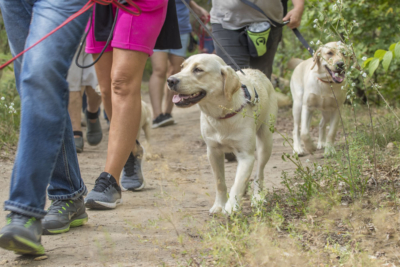

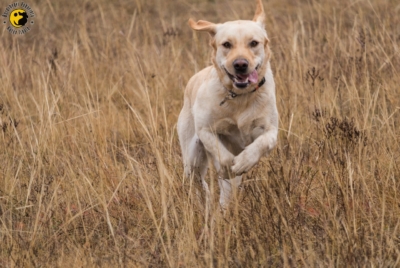
“We recommend to everyone that if you really want your dog to have active recreation, then head to the forest.”
- On our foundation’s YouTube channel, Emese shared how many dogs she started this year with, and after taking a wide turn, why she chose the trainer career path. If you like the video, please subscribe to our YouTube channel.
Nature walks are also a good opportunity for dogs to learn to respect each other
According to Mária Nyíriné Kovács, our guide dog trainer, nature walks provide much useful knowledge (which she will elaborate on), but first she draws attention to an important circumstance:
“The law stipulates (SZMM regulation 2009/27) that in the traffic safety examination of guide dogs, releasing off-leash and recall are mandatory tasks, meaning that the off-leash dog must return to their visually impaired handler when called. This is significant because a visually impaired person needs the sense of security of always knowing where their dog is – in other words, if they release them, the dog should stay nearby, check in frequently, and of course behave well-mannered in every situation.”
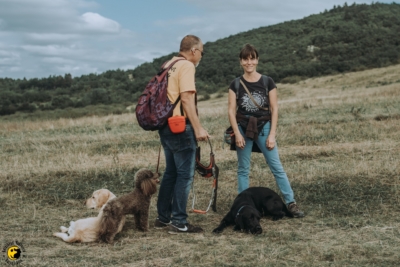
Mária Nyíriné Kovács talks with one of our visually impaired clients
We practice all of this well in advance with dogs living with their puppy raisers until one year of age. Around one to one and a half years old, they move to their trainer, with whom they refine the task, and by one year old they all know the following:
- even when running freely, they don’t go further than 5-10 meters away
- they stay near their handler so they can continuously check in
- which means that every one to two minutes they go back and touch their nose to their handler’s hand or leg.
An interesting question is how we achieve this with our guide dogs. Mária summarized it this way:
“Our one-year-old dogs already know check in perfectly. It may sound strange, but since a Labrador is constantly hungry, after a skillful check in they get a treat along with praise. So why wouldn’t they check in willingly from a young age, and they all level up in this when they want to help their visually impaired handler and don’t do it for the treat anymore, but out of love, sense of duty, and care. Of course, it would be good for “pet” or “hobby dogs” to know this too.”
According to Mária, this is why it’s worth walking and hiking on leash in nature with future guide dogs:
“On forest trails and field paths, dogs and their handlers coming toward us provide very good practice for us. In such cases, we teach our puppy raisers that the dog should walk beside them, because it’s worth being observant and cautious; there’s always some reason why the other dog is on a leash that we don’t know about. Naturally, it’s also important that a guide dog trainee shouldn’t run over, because they could disturb the other dog and their handler. Of course, if there’s an opportunity, we allow sniffing each other – that’s how they get acquainted, and they need to meet unfamiliar dogs. Even if the other dog isn’t on a leash, we’re still cautious. Such an outdoor encounter comes with many lessons – they learn to respect the other dog, as it sometimes happens that an older dog doesn’t appreciate playful approaches, and it’s enough if they just growl, that’s already a good lesson: our young dog learns that it’s not worth being so openly friendly with a stranger. In another case, the lesson is that smaller dogs must be respected, and I could go on.”
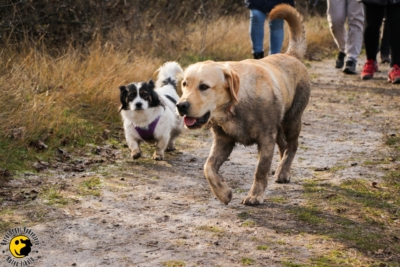
Being in nature is also worthwhile for the beautiful trees, birdsong, and good company. The so-called “Marcsi-runs” are occasions when puppy raisers take weekend walks together, enjoying nature and each other’s company. The walk’s namesake and organizer, Mária, considers this important because:
“Walking together is good for many reasons; for me as a trainer, it’s a joy to see when we go together with 15-20 dogs. Meanwhile, we chat, and I can help puppy raisers with important questions. I also see how they work together with their dog, and I can give advice on fundamental matters that might not otherwise have come up.”
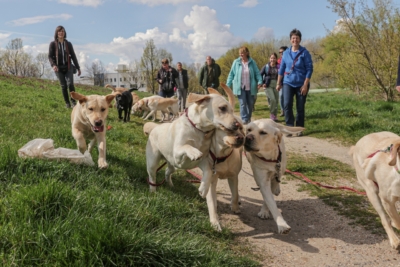
Mária explained that hiking with dogs is also a responsibility, which is why they don’t allow the dogs further than 5-10 meters away, but discipline is rarely needed because of this, as the need to check in is so ingrained in them. The group isn’t just about dogs: “I pay close attention to ensure no one is alone; I speak to everyone. Perhaps this is also why inactive puppy raisers who don’t have a dog at the moment join us; this isn’t a problem, we have enough dogs, they get one for the walk. For those who love nature, the company of dogs and people, hiking together is the best activity.”
- Mária regularly appears on our YouTube channel; in our latest short film we get a glimpse into the first phase of Hargita’s training. If you like the video, please subscribe to our YouTube channel.

Exclusive Newsletter for Everyone!
Be the first to receive updates on the development of Topáz’s puppies!
Subscribe to our email newsletter and follow Topáz’s puppies for 8 weeks with exclusive content.In our newsletters, we also share information and stories about them that you won’t find anywhere else.
Join us on this exciting journey — the subscription link to our newsletter is available HERE.If you’re already a subscriber and enjoy our newsletters, we kindly ask you to invite your friends by sending them the link to this article or the subscription page.
Thank you!
The Baráthegyi Team

Leave a Reply