


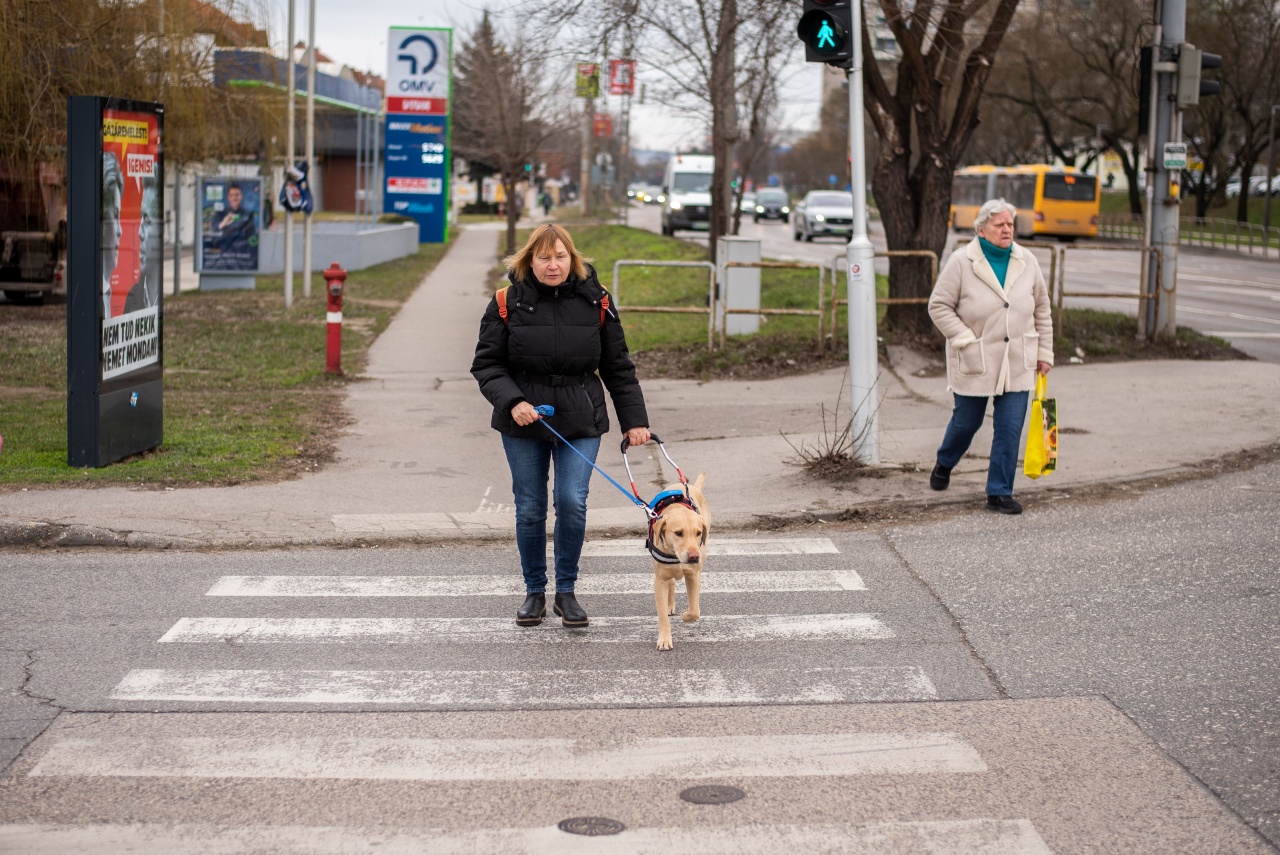
They insulted one of our clients on the bus simply because far too few people are aware of the long‑standing regulation that allows guide dogs to travel without a muzzle. Margit Kovács has already faced several unpleasant and hurtful situations on the Keszthely–Sümeg bus line because of this. She submitted a complaint to the MÁV Group, but the response she received was ambiguous.
In addition to training guide dogs, our foundation is also committed to raising awareness and supporting a more informed, inclusive attitude. As part of this mission, we would like to draw attention—with the intention of helping and improving—to the proper observance of the assistance dog regulations that apply to guide dogs as well.
Margit’s complaint is that, after a needless argument, the bus driver only set off with her reluctantly. She had to argue for her right to travel with her guide dog unmuzzled, even though a regulation—valid for 17 years and applicable on buses as well—explicitly permits this.
In early January, Margit and her guide dog, Alfa, were waiting for a long-distance bus in Keszthely. She explained that they were heading to Sümeg and then back to their home in Budapest. While boarding, the bus driver demanded that she put a muzzle on her guide dog before departure. After an uncomfortable exchange, this ultimately did not happen—rightfully so—because the regulation that allows guide dogs to travel without a muzzle has been in force for 17 years. Alfa was in a guide dog harness, clearly identifiable as working. Our client is a rule‑abiding person, and she also had Alfa’s certification with her.
“It would have been hurtful even for a sighted person to be insulted by several strangers at once in a public place. Now imagine what it feels like for someone who is visually impaired — someone who cannot clearly tell who is shouting at them, cannot look the person in the eye, and cannot respond directly. I felt deeply humiliated. And all of this could have been avoided if the regulation on guide dogs had simply been followed. After so many similar incidents, this was the last straw for me, and I decided to submit a formal complaint to the MÁV Group.”
– said Margit Kovács. Our foundation has been operating for 20 years. We provide guide dogs free of charge and support the safe mobility of people with visual impairments. Part of our mission is to promote public awareness — including drawing attention, with the intention of improvement, to the proper observance of the assistance‑dog regulation that also applies to guide dogs.

The passengers on the bus turned against her
In her letter to the MÁV Group — which acts on behalf of Volánbusz in such matters — Margit Kovács wrote the following:
“I regularly use public transport all over the country without any issues. However, this is not the first time I’ve encountered this problem on the Keszthely–Sümeg line. Each time, I have reminded the drivers that guide dogs are not required to wear a muzzle under the relevant regulation. On some occasions we were allowed to board without further debate, but sadly there were also times when I had to persuade the driver just to let us on the bus.”
Margit explained that other passengers usually do not stay silent during such situations; sometimes they even divide into two camps, and at least a few stand by her side. This time, however, most passengers turned against her and made remarks she never wants to be subjected to again — which is why she decided to file a written complaint. She continued her letter to the MÁV Group as follows:
“After the difficult boarding, even during the rest of the journey, the passengers did not accept that my guide dog was travelling without a muzzle, and they openly voiced their disapproval. Yet according to the regulation that applies to them as well, guide dogs are not required to wear a muzzle. This means they are allowed to travel on public transport without one. To avoid further unpleasant situations, I kindly ask you to inform your employees about this regulation.”
Our client is completely right: the cited regulation states that a visually impaired person accompanied by a guide dog has the right to enter and remain in facilities open to the public — including public transport vehicles — and that guide dogs are not required to wear a muzzle. In other words, these dogs are legally allowed to travel on public transport without a muzzle.
(Government Decree 27/2009. (XII. 3.) SZMM on the training, examination and use of assistance dogs.)

A “yes and no” kind of answer
In its response, the MÁV Group’s customer service wrote that they were “deeply sorry” to hear about the unpleasant incident involving the guide dog team, and that during the investigation of the complaint they conducted the necessary employer procedure and interviewed the bus driver:
“The bus driver stated that you were waiting at the platform in Keszthely with your dog. When boarding the bus, he informed you that, for the safe provision of the journey, the dog must wear a muzzle. You then indicated that you were travelling with an assistance dog, which is not required to wear a muzzle. He therefore allowed you to travel. He did not notice what happened between you and the other passengers on board. The vehicle in question is not equipped with an onboard camera system. We have reminded our bus driver to perform his duties in accordance with the regulations, to comply with the rules on transporting live animals, and to provide service with an appropriate customer‑oriented approach.”
The customer service then apologized for what had happened and for the inconvenience caused, adding that they hoped “no similar incident has occurred since, and that you have been satisfied with our services in the meantime.”
They went on to explain the section of their transport regulations concerning live animals allowed on buses:
“When transporting an assistance dog, the use of a muzzle and a leash may be omitted when justified.”
A new initiative has begun: the MÁV Group’s business regulations should be aligned with the assistance‑dog legislation!
Margit Kovács told us that she responded to this part in writing and forwarded it to the MÁV Group. In her view, the MÁV Group is — incorrectly — allowing discretion in a matter that is clearly defined in a stronger, higher‑level piece of legislation from 2009 (Government Decree 27/2009. (XII. 3.) SZMM on the training, examination and applicability of assistance dogs), which states the following:
A visually impaired person accompanied by a guide dog has the right to enter and remain in facilities open to the public, including public transport vehicles. Guide dogs are not required to wear a muzzle.
(Section 10 (2) of the decree states: “A person using an assistance dog may use the assistance dog without a muzzle.”)
This means that these dogs are legally allowed to travel on public transport without a muzzle.
In her opinion, it is justified and necessary to amend the MÁV Group’s business regulations as follows:
“During the transport of an assistance dog, the use of a muzzle and a leash may be omitted.”
In other words, the decision should be made by the visually impaired handler — not by the driver, nor by any third party who has no authority to override what the law explicitly states.
Margit Kovács wrote the following:
“In the current situation, due to the incorrect legal interpretation found in the MÁV Group’s business regulations, one of the rights of visually impaired people travelling with a guide dog is being violated. This leads to arguments, unpleasant situations and journeys filled with tension. I kindly ask you to consider the possibility of amending the regulation, and I request that you inform me of your decision.”
Our client is now waiting for the MÁV Group’s response, which we will share once it arrives.
Many people all over the country are waiting for our guide dogs!
Please support their training with 1% of your personal income tax!
Our tax number: 18449149–1–05
Baráthegyi Guide and Assistance Dog School Foundation
You can now donate 1% of your personal income tax on the NAV (NTCA – National Tax and Customs Administration of Hungary) online interface by logging in here on your customer portal.

Leave a Reply